
To support good health it is nearly always appropriate to increase the amount of vegetables that we eat. Most vegetables are naturally low in calories but high in valuable nutrients, including potassium, dietary fibre, folic acid, vitamin A, and vitamin C. Anyone following an anti-candida diet can enjoy using an abundance of vegetables, whether steamed, roasted, baked, or raw in salads and vegetable smoothies
The list of nutritional benefits really can go on, so it is no surprise to hear that most nutritional therapists suggest that we try to include 10 servings of veg a day, rather than the government recommendation of 5 servings a day. Aim to use a cross-section of different coloured vegetables (for their various nutrient contents) and experiment with vegetables which might easily be overlooked – such as celeriac
 Celeriac
This knobbly root vegetable is sometimes called celery root or knob celery. It has a similar number of calories per 100g as carrots, but has less natural sugars than carrot. Celeriac contains good levels of vitamin B6, which is vital for enzyme function, and multiplication of cells (critical for pregnancy, immune health, mucous membranes, skin and red blood cells), while also being important for brain chemistry. Its delicate nutty, celery-type flavour means that celeriac can be easily included in soup, casseroles and stews, while also being delicious if kept raw and added to salads. Grate or finely chop if you want to use celeriac uncooked. Here are some more ideas to incorporate celeriac into your meals.

Chop through the celeriac into rounds. Peel the tough skin and chop into ‘chips’.

Place on a baking tray and drizzle with extra virgin olive oil. Toss to cover well with the oil, and bake at 180 degrees celsius for 45 minutes, stirring several times, until soft and golden.

Celeriac can easily be used in place of potato – boiling, roasting or mashing. An idea for mashed celeriac is to chop it into cubes an add to a pan with a clove of garlic, a teaspoon of extra virgin olive oil and a dash of water.

Stir well, add a lid and ‘steam fry’ for a few minutes to bring out the flavour of the garlic. Add 1/2 cup of water, replace the lid and continue to cook until celeriac is soft. Smash with a potato masher, or whizz in a food processor. Serve topped with freshly ground black pepper

Grate 1/4 of a peeled celeriac and place in a bowl with a large egg.

Mix well, adding 1/4 teaspoon of turmeric, 1/4 teaspoon of black onion seeds and 1/4 teaspoon of mustard seeds, or alternatively you can keep things simple and just use 1/2 teaspoon of dried chives. Mould the mixture into satsuma-size balls and flatten. Place onto a hot pan with some melted coconut oil.

Turn the heat down, place a lid on the pan and cook for 5 minutes. Carefully flip over, replace the lid and cook for a further 5 minutes or until the Hash-Browns are golden.

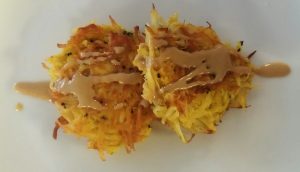
Use for a breakfast or lunch dish topped with a poached egg or drizzled with tahini.

Grate a 1/4 of a celeriac bulb and mix with an egg as above. Add 1/4 teaspoon of oregano. Place mixture into a hot pan with 2 teaspoons of melted coconut oil, and form into a circle to make the tart base, patting down to a thickness of 1 cm.

Place a lid on the pan and cook for 5 minutes. To flip the base over, loosen the celeriac carefully from the pan with a fish slice, place a large plate over the top of the pan and invert.

The celeriac tart base should now be upside-down on the plate.

Slide the base back into the pan and cook for a further 5 minutes. Carefully slide the base onto a baking tray, ready for the topping.

For the topping, roast 2 cups of assorted vegetables and stir in a tablespoon of tomato puree. Spoon over the tart base. Top with fresh-cracked walnuts or hazelnuts, or sunflower and pumpkin seeds. Bake at 170 degrees celsius for 10 minutes and serve with a crisp side-salad.
